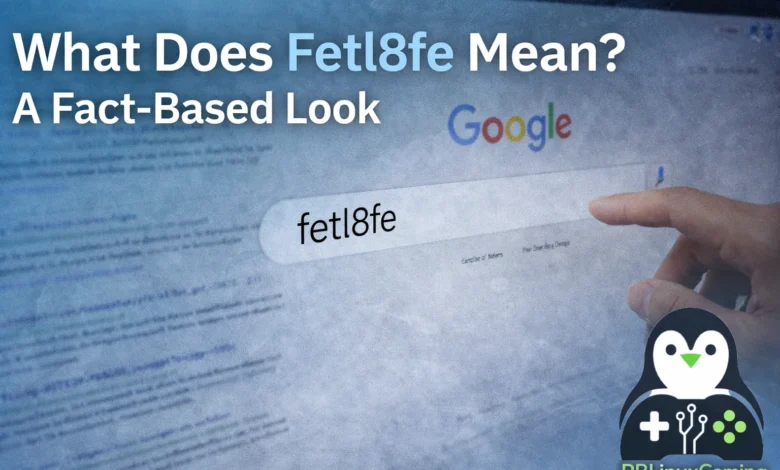
The term fetl8fe does not have a clear, widely documented public meaning based on current search results. When searched, it does not produce the kind of clean result pattern you would expect from a recognized brand, product, service, or established topic. Instead, the public web shows a mixed picture: one visible result is an Instagram page built around the same text, while the clearest authoritative references in related results point to FetLife, a real social networking platform for people interested in fetish, BDSM, and kink.
That mismatch matters. A normal search term usually leads to a reliable cluster of pages that explain what it is. Here, the strongest public footprint belongs to FetLife, not to fetl8fe itself. The result is confusion: users may be looking at a typo, a distorted variation, a social tag, or a string that appears on low-value pages without a stable meaning.
So the best fact-based approach is not to invent a definition. It is to examine what the web actually shows, identify the most plausible explanations, and explain how to verify a strange term safely. That is what this article does.
What the public web actually shows
The result pattern is weak and inconsistent
When a term has a real public identity, search results usually reveal a clear source trail. You normally see an official site, documentation, reviews, press mentions, or repeated explanations from reputable sources. With fetl8fe, that pattern is missing. The visible result set is thin and inconsistent, with an Instagram page for the exact string and stronger related references that describe FetLife, not fetl8fe as a standalone topic.
This is the first important takeaway: there is no strong evidence from authoritative public sources that fetl8fe is a clearly established term with its own verified meaning. The available evidence points more toward ambiguity than definition.
A visible link to FetLife exists
The clearest related source trail leads to FetLife. Public references describe FetLife as an adult social networking website or a social network for the fetish community. Wikipedia describes it as a social networking site for people interested in BDSM, fetishism, and kink, while Australia’s eSafety Commissioner describes it as a social network for the fetish community with profiles, messaging, following, and content posting features.
Because fetl8fe visually resembles FetLife, it is reasonable to consider the possibility that some users or pages are dealing with a misspelling, altered spelling, or typo-like variation. Still, the available public evidence does not prove that every appearance of fetl8fe means FetLife. The responsible conclusion is narrower: there is a visible association, but not a fully verified one-to-one definition.
Social usage alone is not enough to define it
The Instagram result shows that the string fetl8fe is being used online in some form. But that does not automatically turn it into a recognized concept. Many odd strings exist online as usernames, hashtags, tags, auto-generated labels, or fragments copied from elsewhere. A social page can confirm that the text exists in public, but it does not prove meaning, authority, or trust.
That distinction is important for readers. A term can be searchable without being clearly explainable.
The most likely explanations
A typo or altered spelling is plausible
Based on the result pattern, the most plausible explanation is that fetl8fe may be a typo-like or distorted version of FetLife. That explanation fits the visible character overlap and the fact that more trustworthy related sources describe FetLife, while fetl8fe itself lacks a comparable source footprint.
Typos and altered spellings are common online for simple reasons:
- users make keyboard errors
- copied text gets distorted
- bots and scraped pages reproduce mistakes
- odd strings survive in tags and page fragments
None of that proves the term’s exact origin, but it does help explain why a strange variation can appear across the web without developing a clear public definition.
A niche tag is also possible
Another possibility is that fetl8fe is being used as a niche label or informal tag rather than a recognized topic. The Instagram result supports the idea that the string is being reused in social contexts, even if no reliable source explains what it is supposed to mean.
This possibility matters because some terms become searchable simply through repeated use, not because they were ever formal names. In those cases, a string may circulate online while remaining vague to anyone outside the small context in which it is used.
A low-value search string is also possible
A third possibility is that fetl8fe is simply one of many odd strings that appear on weak or low-value pages. A Snaptroid article explicitly frames fetl8fe as an example of a suspicious or nonsense search term that can show up in risky online contexts. That source is not authoritative enough to settle the question by itself, but it does reflect the broader pattern of ambiguity around the term.
The safest conclusion is that the public web does not support a single clean definition. Instead, it supports a short list of plausible explanations, with the typo-like link to FetLife standing out as the strongest one currently visible.
Why this matters for users
Confusing search terms can send people to the wrong places
The term itself is not the main risk. The bigger issue is where it may lead. When search results are unclear, thin, or inconsistent, users can end up clicking into pages that do not explain anything well, collect traffic from unrelated queries, or point toward unsafe destinations. Google’s Safe Browsing documentation explains that Safe Browsing checks URLs against constantly updated lists of unsafe web resources, including phishing, deceptive sites, malware, and unwanted software.
That does not mean every odd term is dangerous. It means uncertainty is a reason to slow down. If a search does not produce a trustworthy explanation, users should verify before clicking deeper, downloading files, or entering personal information. That is especially true when the visible result set does not show a clear official source.
Privacy concerns can matter more when adult-oriented results appear nearby
Because the most credible related references point to FetLife, privacy becomes even more relevant. The eSafety Commissioner’s overview of FetLife explains that it is a social network where users can create profiles, share content, follow others, and manage visibility settings. That kind of platform naturally raises questions about privacy, identity exposure, and content visibility.
So even if a user is only trying to figure out what fetl8fe means, the nearby result environment may include adult-community references. That is another reason to verify carefully rather than assume the term is harmless or straightforward.
What the evidence does and does not support
What the evidence supports
The public evidence supports several careful conclusions:
- fetl8fe does not currently have a strong, independently verified public definition.
- Related search results show a visible overlap with FetLife, which is a real social networking platform for fetish, BDSM, and kink communities.
- The exact string fetl8fe appears in public social usage, at least through an Instagram page.
- Safety guidance from Google supports extra caution around unclear or potentially risky destinations.
What the evidence does not support
Just as important, the public evidence does not support these stronger claims:
- it does not prove that fetl8fe is an official brand or service
- it does not prove that every use of the string means FetLife
- it does not prove that the term is malicious by itself
- it does not provide a clear origin story from a trusted source
That distinction keeps the article accurate. A fact-based piece should stop where the evidence stops.
How to verify fetl8fe safely
Search the exact term first
The first step is simple: search the exact string in quotation marks. This helps show whether the term has its own consistent identity online or whether search engines mostly connect it to other words and pages. If the results remain thin and inconsistent, that is useful information by itself.
Then compare those results with searches for likely alternatives, especially FetLife. If the second search immediately produces clearer and more authoritative information, that tells you the original string may be a variation rather than a stable term of its own.
Check for a trustworthy source trail
A real public term usually leaves a strong source trail. Look for:
- an official website
- documentation or help pages
- reliable media coverage
- repeated explanations from trusted sources
- consistent naming across multiple reputable domains
For fetl8fe, that trail is weak. For FetLife, it is much stronger, with public descriptions from Wikipedia and the eSafety Commissioner.
Read must: Company Website ShopNaclo: What Users Should Know
Watch for vague or recycled pages
If you land on a page that repeats odd terms without clear explanation, be careful. Weak pages often use copied phrases, strange strings, vague headings, or broad topic mixing without actually defining anything. That kind of page is not useful for understanding what a term means, and it may be trying to collect search traffic rather than help users.
The available public results around fetl8fe are already thin enough that any vague page should be treated with skepticism. A reliable source should explain the term directly and stay on topic.
Use browser safety features
Google explains that Safe Browsing is designed to identify unsafe websites and notify users and site owners of potential harm, while Chrome support documentation says Safe Browsing helps protect users from websites associated with malware, phishing, intrusive ads, and social engineering. That makes built-in browser protection a practical part of verification, especially when you are dealing with unclear search results.
Be careful with personal details
If an unclear term leads you toward a login page, unfamiliar social site, or page asking for sensitive information, stop and verify before going further. This is especially relevant when the result environment includes adult-community references or social profiles, where privacy risks can be higher. The eSafety Commissioner’s FetLife guide focuses heavily on account safety, visibility, and safer platform use, which supports a cautious approach here as well.
What most readers are really trying to find out
People searching fetl8fe are usually not looking for a long technical explanation. They are trying to answer a few practical questions.
Is it a real thing?
There is not enough authoritative public evidence to say that fetl8fe is a recognized standalone thing in the way a normal brand, product, or topic would be. The evidence is too thin and too inconsistent for that.
Is it related to FetLife?
Possibly, yes. That is the strongest visible explanation right now, because the related authoritative references are about FetLife, and the strings resemble each other closely. But “possibly related” is still more accurate than “proven identical.”
Should you trust pages that use it?
Not automatically. If a page uses the string but does not explain it clearly, that page has not earned trust. If the page also looks cluttered, vague, or overly broad, it is better to leave and keep checking other sources. Google’s Safe Browsing guidance supports that cautious behavior when dealing with potentially deceptive or risky destinations.
Quick summary points
- fetl8fe does not currently have a clear, verified public meaning.
- The strongest related explanation is a possible connection to FetLife, a real social network for fetish, BDSM, and kink communities.
- The exact string appears in public social usage, but that alone does not establish a formal definition.
- The safest approach is to verify carefully, look for trustworthy sources, and rely on browser safety tools when results seem unclear.
FAQs
What does fetl8fe mean?
Based on current public search results, fetl8fe does not have a clearly verified standalone meaning. The strongest visible related connection is to FetLife, but the evidence does not fully prove that every use of the string means the same thing.
Is fetl8fe an official website?
There is no strong authoritative public evidence showing fetl8fe as an official website, recognized brand, or documented service of its own.
Is fetl8fe a typo for FetLife?
It may be. That is the most plausible explanation visible in public results, but it cannot be stated as fully proven based on the available evidence alone.
Is fetl8fe dangerous?
The string itself is not proven dangerous. The real concern is that unclear searches can lead users to low-trust, deceptive, or unsafe pages, which is why Google Safe Browsing guidance is relevant here.
What should you do if you find it online?
Search the exact term, compare it with likely alternatives such as FetLife, check whether reliable sources explain it, and avoid sharing personal information on unfamiliar pages before verifying them.
Final Thoughts
The public web does not currently support a strong, independent definition for fetl8fe. What it does show is a weak and mixed result pattern, a visible social-use trace, and a plausible connection to FetLife, which has a much clearer public identity.
So the most accurate, useful answer is also the simplest one: fetl8fe appears to be an unclear or typo-like term rather than a well-established topic with a stable public meaning. Until stronger evidence appears, the safest response is to verify carefully, prefer trusted sources, and treat unclear result pages with caution.